coding
12 Essential Programmer Concepts
#programmingconcepts #systemdesign #security #coding #datastructures #algorithms #networking #versioncontrol #git #databases #api #agile
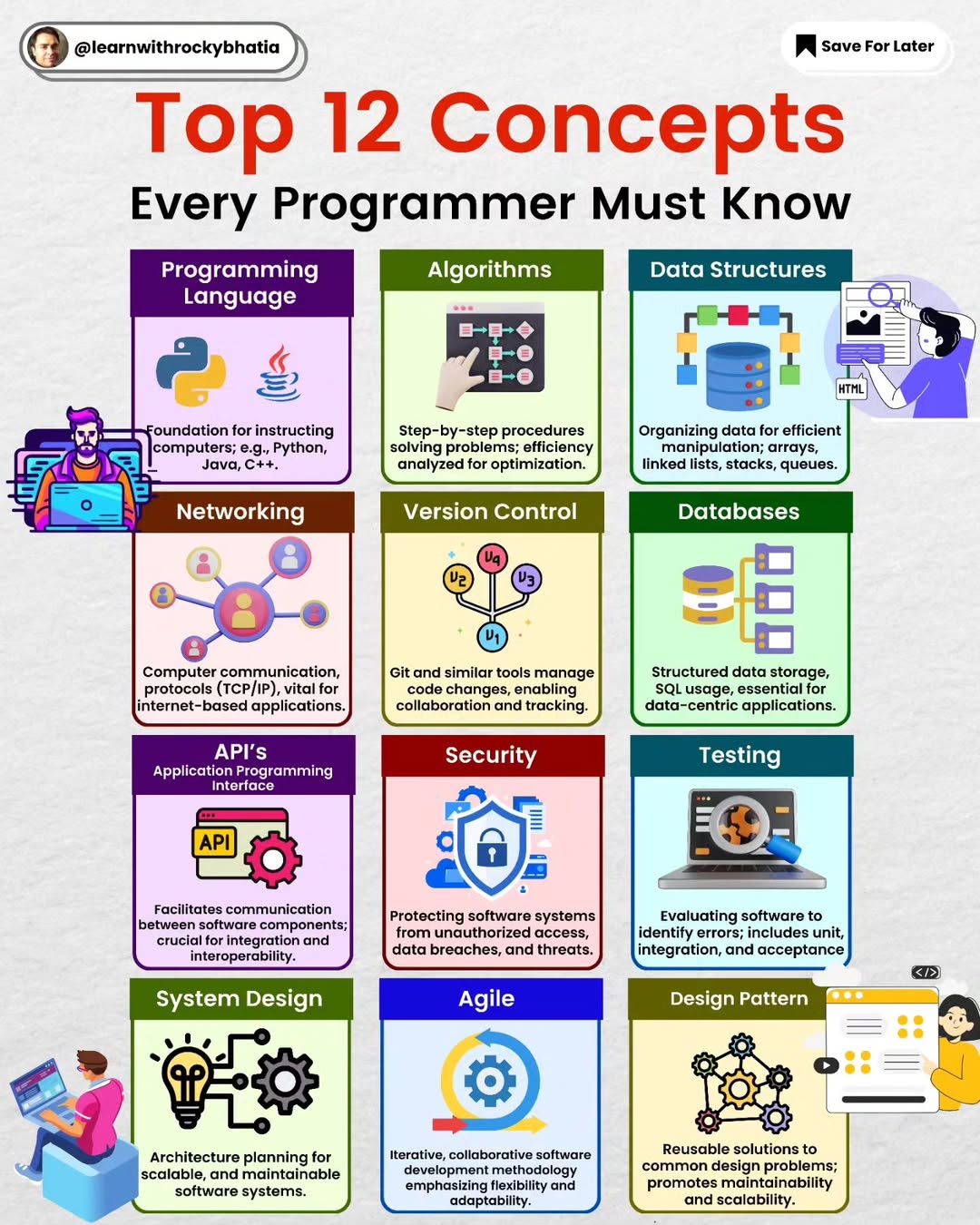
These comprehensive set of concepts forms a strong foundation for programmers, covering a range of skills from programming fundamentals to system design and security considerations.
1. Introduction to Programming Languages: A foundational understanding of at least one programming language (e.g., Python, Java, C++), enabling the ability to comprehend and switch between languages as needed.
2. Data Structures Mastery: Proficiency in fundamental data structures such as arrays, linked lists, stacks, queues, trees, and graphs, essential for effective algorithmic problem solving.
3. Algorithms Proficiency: Familiarity with common algorithms and problem solving techniques, including sorting, searching, and dynamic programming, to optimise code efficiency. ** 4. Database Systems Knowledge:** Understanding of database systems, covering relational databases (e.g., SQL) and NoSQL databases (e.g., MongoDB), crucial for efficient data storage and retrieval.
5. Version Control Mastery: Proficiency with version control systems like Git, encompassing skills in branching, merging, and collaboration workflows for effective team development.
6. Agile Methodology Understanding: Knowledge of the Agile Software Development Life Cycle (Agile SDLC) principles, emphasizing iterative development, Scrum, and Kanban for adaptable project management.
7. Web Development Basics (Networking): Fundamental understanding of networking concepts, including protocols, IP addressing, and HTTP, essential for web development and communication between systems.
8. APIs (Application Programming Interfaces) Expertise: Understanding how to use and create APIs, critical for integrating different software systems and enabling seamless communication between applications.
9. Testing and Debugging Skills: Proficiency in testing methodologies, unit testing, and debugging techniques to ensure code quality and identify and fix errors effectively.
10. Design Patterns Familiarity: Knowledge of common design patterns in object-oriented programming, aiding in solving recurring design problems and enhancing code maintainability.
11. System Design Principles: Understanding of system design, including architectural patterns, scalability, and reliability, to create robust and efficient software systems.
12. Security Awareness: Fundamental knowledge of security principles, including encryption, authentication, and best practices for securing applications and data.
Other areas could be OS, containers, concurrency and parallelism , basic web development etc.
Good Code Principles
#cleancode #goodcode #coding #principles
It’s not just about writing code that works.
It’s about writing code that is robust, secure, maintainable, scalable, and testable.
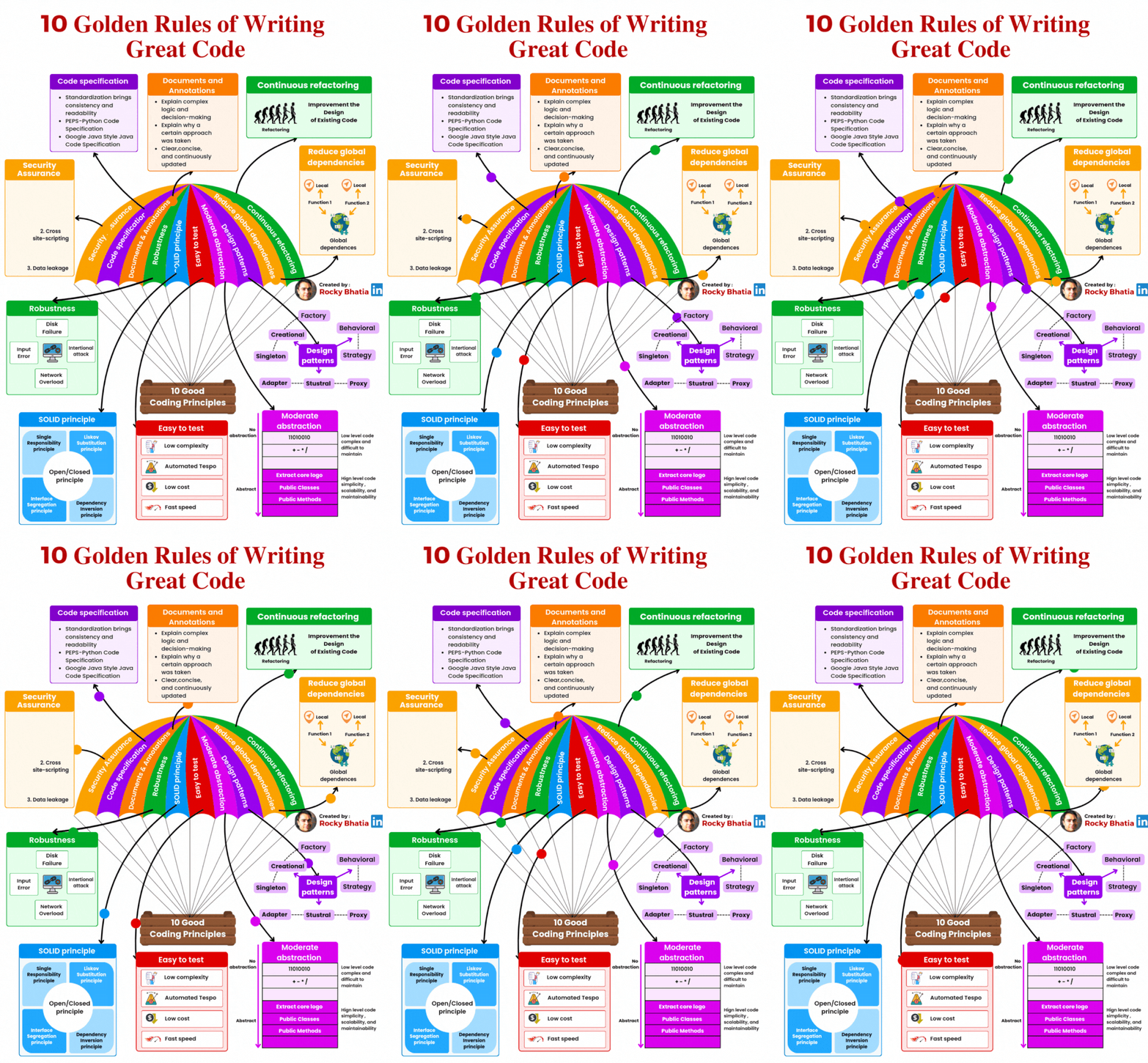
Here are the 10 Best Coding Principles every developer should embrace:
1️⃣ Code Specification – Follow standards like PEP8 or Google Java Style to ensure readability. 2️⃣ Clear Documentation & Annotations – Explain the why, not just the what. 3️⃣ Security Assurance – Code defensively to avoid data leaks and cross-site scripting. 4️⃣ Robustness – Build for failures like input errors, disk issues, or network overload. 5️⃣ SOLID Principles – The foundational pillars of clean object-oriented design. 6️⃣ Easy to Test – Low complexity, low cost, and high speed testing wins. 7️⃣ Moderate Abstraction – Not too raw, not too abstract. Just enough to simplify. 8️⃣ Design Patterns – Use patterns like Factory, Singleton, Strategy, etc. wisely. 9️⃣ Reduce Global Dependencies – Keep your code modular and loosely coupled. 🔟 Continuous Refactoring – Improve design continuously without breaking functionality.