datastructures
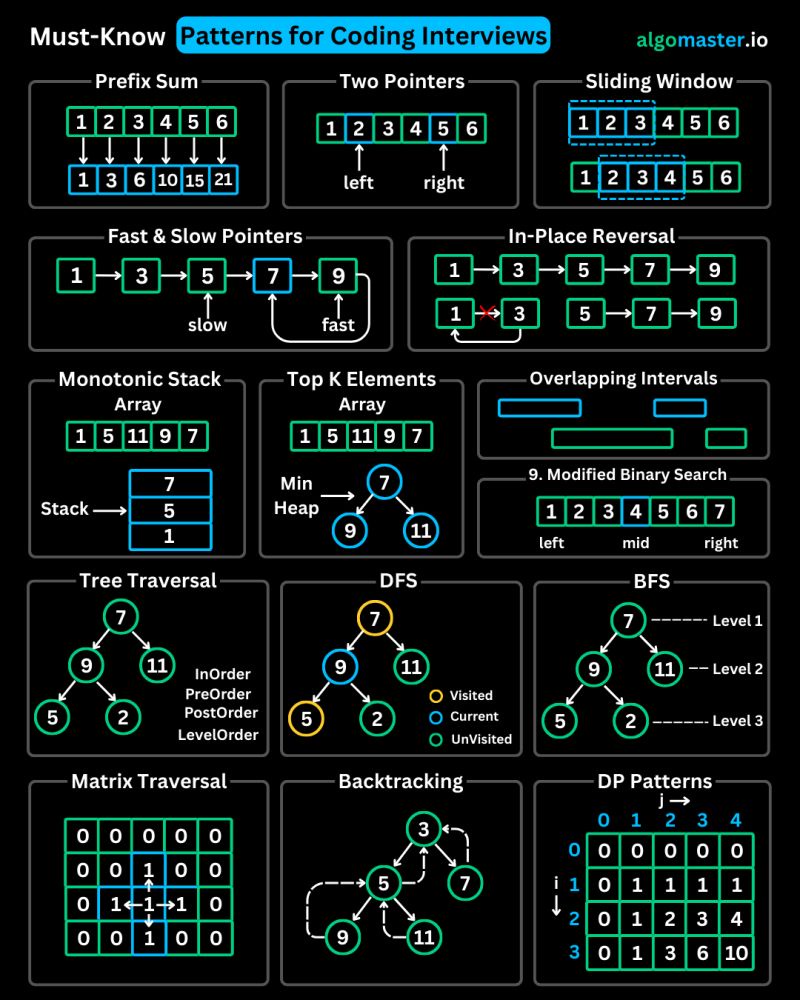
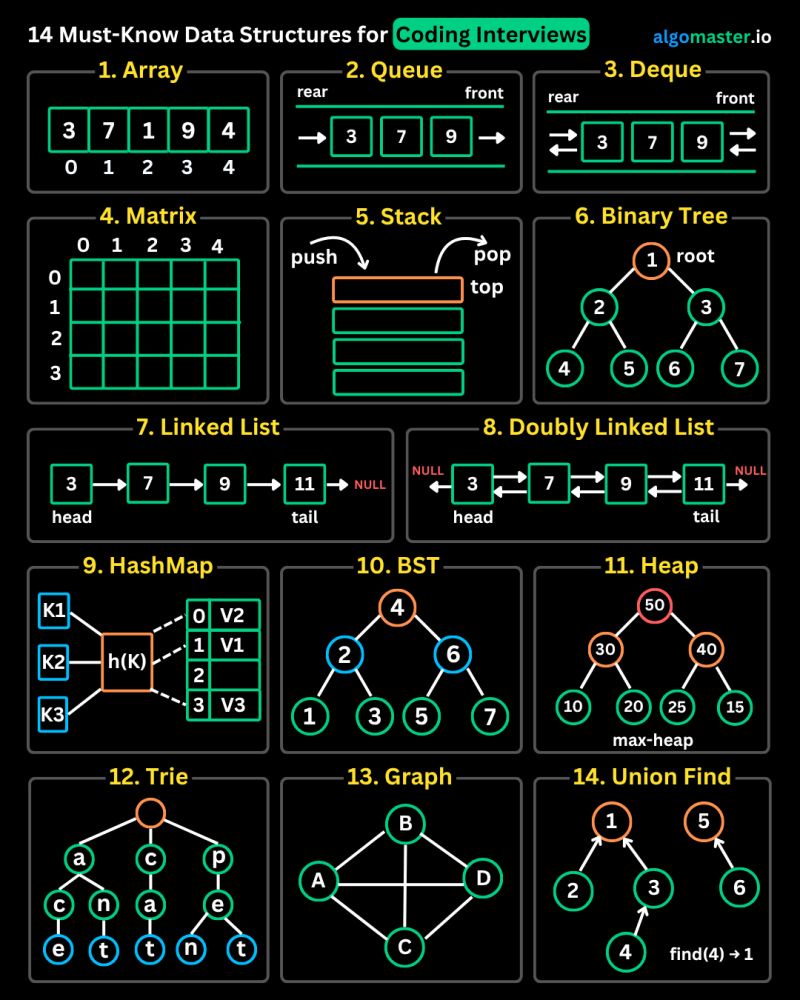
Must Know Data Structures
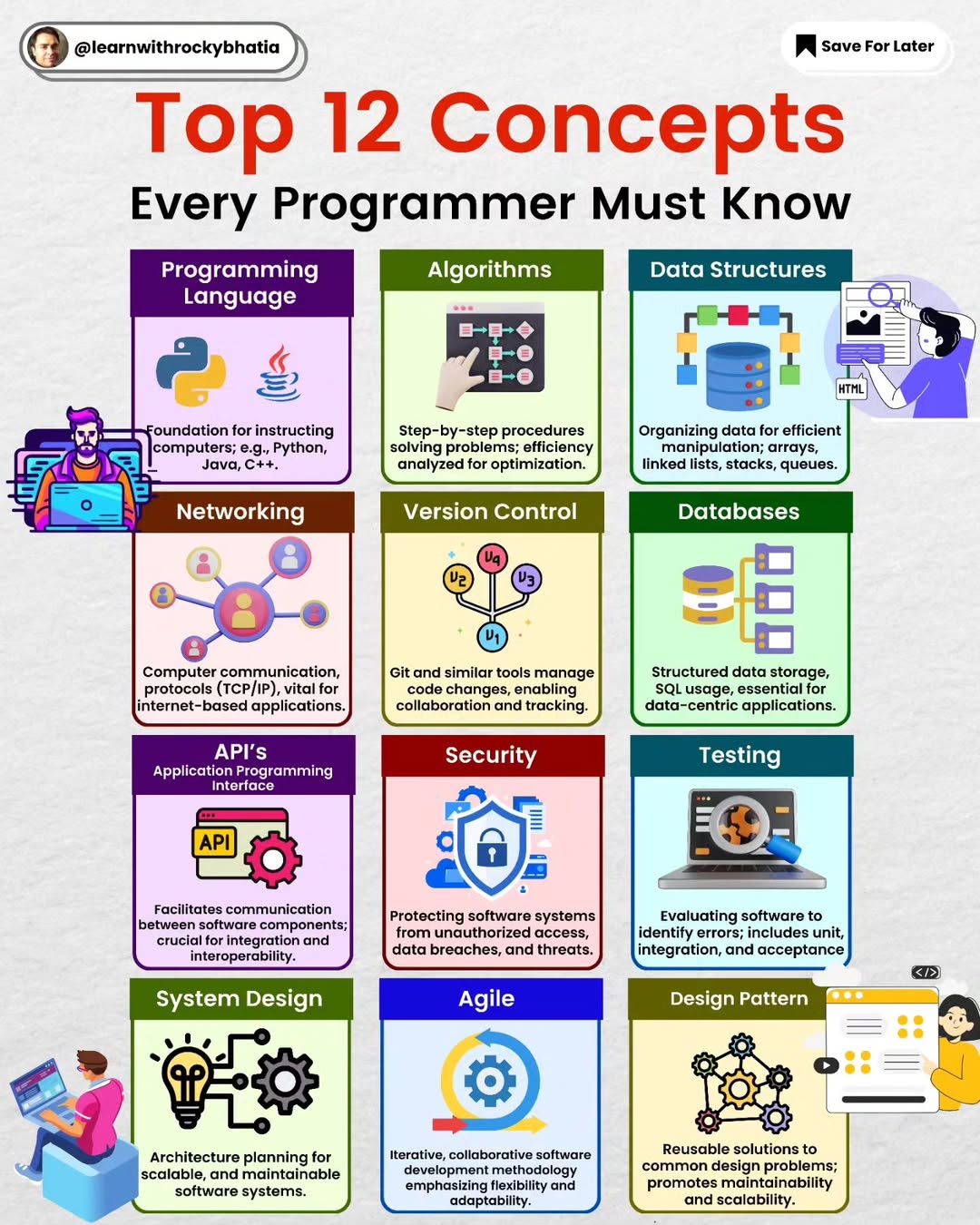
12 Essential Programmer Concepts
#programmingconcepts #systemdesign #security #coding #datastructures #algorithms #networking #versioncontrol #git #databases #api #agile
These comprehensive set of concepts forms a strong foundation for programmers, covering a range of skills from programming fundamentals to system design and security considerations.
1. Introduction to Programming Languages: A foundational understanding of at least one programming language (e.g., Python, Java, C++), enabling the ability to comprehend and switch between languages as needed.
2. Data Structures Mastery: Proficiency in fundamental data structures such as arrays, linked lists, stacks, queues, trees, and graphs, essential for effective algorithmic problem solving.
3. Algorithms Proficiency: Familiarity with common algorithms and problem solving techniques, including sorting, searching, and dynamic programming, to optimise code efficiency. ** 4. Database Systems Knowledge:** Understanding of database systems, covering relational databases (e.g., SQL) and NoSQL databases (e.g., MongoDB), crucial for efficient data storage and retrieval.
5. Version Control Mastery: Proficiency with version control systems like Git, encompassing skills in branching, merging, and collaboration workflows for effective team development.
6. Agile Methodology Understanding: Knowledge of the Agile Software Development Life Cycle (Agile SDLC) principles, emphasizing iterative development, Scrum, and Kanban for adaptable project management.
7. Web Development Basics (Networking): Fundamental understanding of networking concepts, including protocols, IP addressing, and HTTP, essential for web development and communication between systems.
8. APIs (Application Programming Interfaces) Expertise: Understanding how to use and create APIs, critical for integrating different software systems and enabling seamless communication between applications.
9. Testing and Debugging Skills: Proficiency in testing methodologies, unit testing, and debugging techniques to ensure code quality and identify and fix errors effectively.
10. Design Patterns Familiarity: Knowledge of common design patterns in object-oriented programming, aiding in solving recurring design problems and enhancing code maintainability.
11. System Design Principles: Understanding of system design, including architectural patterns, scalability, and reliability, to create robust and efficient software systems.
12. Security Awareness: Fundamental knowledge of security principles, including encryption, authentication, and best practices for securing applications and data.
Other areas could be OS, containers, concurrency and parallelism , basic web development etc.
Data Structures & Algorithms
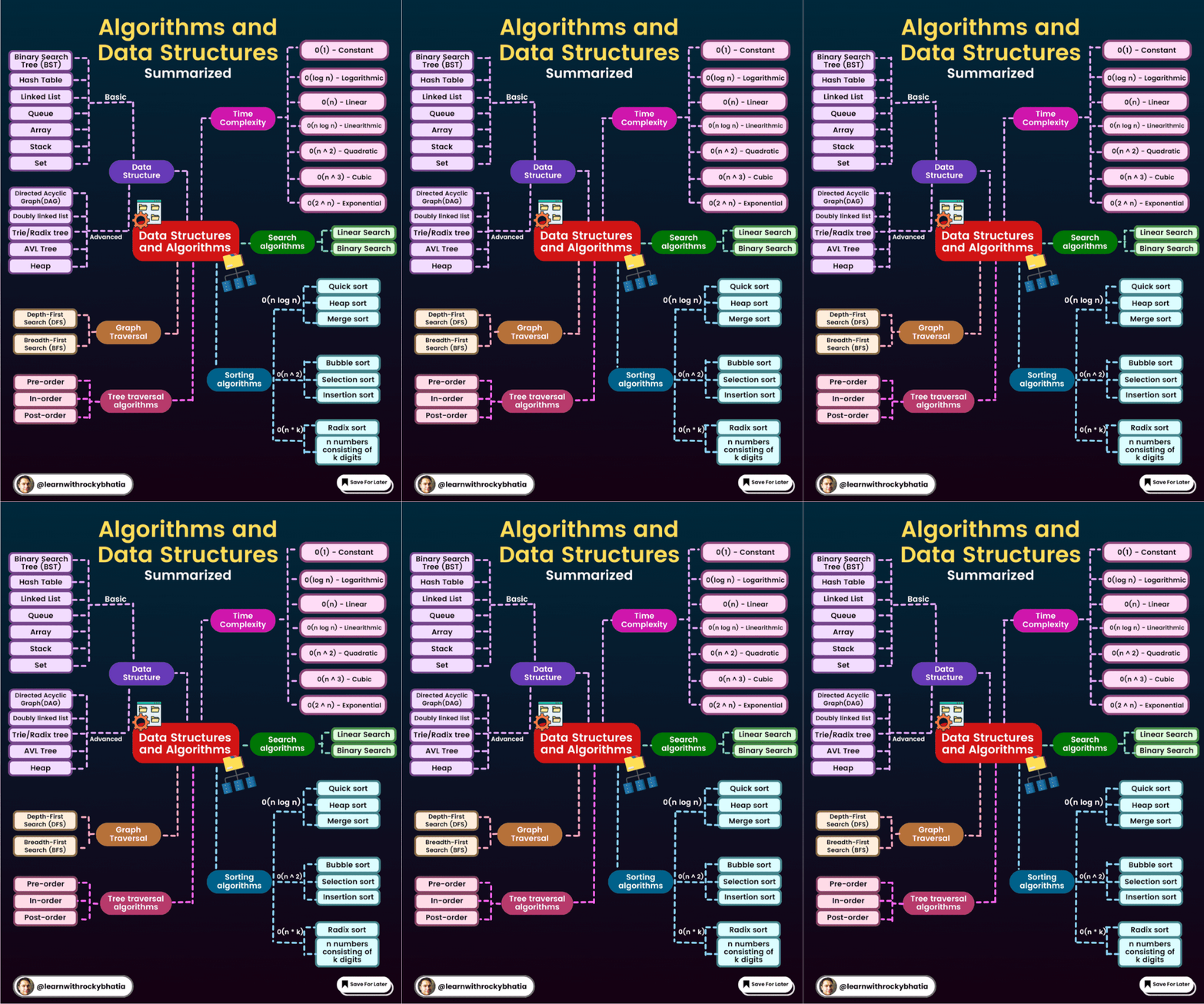
Data Structures and Algorithms
Primitive Data Structures
• Integers • Floating-point numbers • Characters • Boolean values
Non-Primitive Data Structures
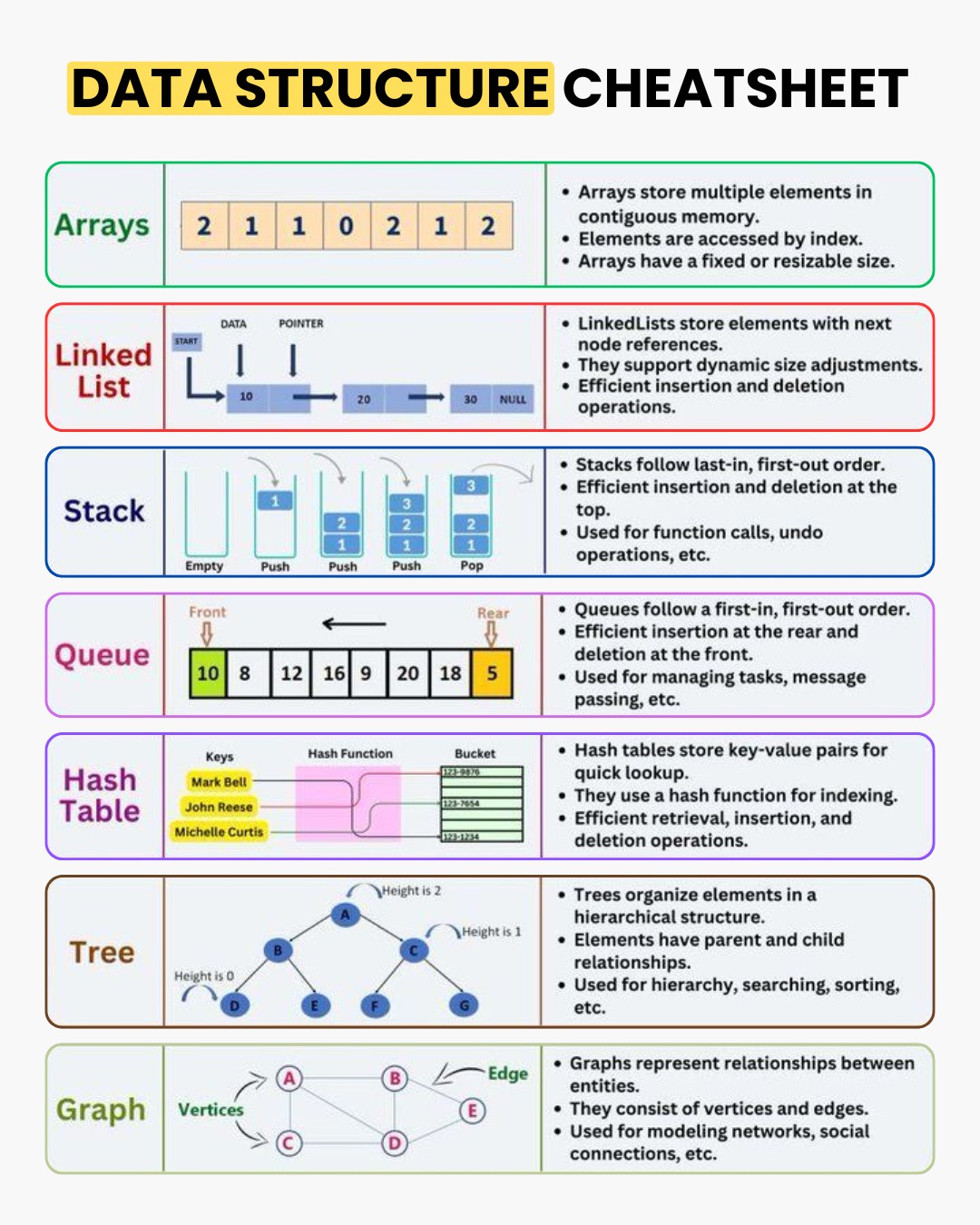
• Arrays: Fixed-size sequence of elements, efficient for random access but inefficient for insertions/deletions. • Linked Lists: Dynamic structure of nodes linked by pointers, efficient for insertions/deletions at any position but slower random access. • Stacks: LIFO (Last-In-First-Out) order, used for function calls and expression evaluation. • Queues: FIFO (First-In-First-Out) order, used for scheduling and task management. • Trees: Hierarchical structures with a root node, used for representing hierarchical relationships (e.g., binary trees, n-ary trees). • Graphs: Collections of nodes (vertices) connected by edges, used for representing networks and relationships. • Hash Tables: Data structures that use hashing to store and retrieve data efficiently, often used for implementing dictionaries and databases.
Choosing the right data structure depends on factors such as:
• Data type and volume • Required operations (insertion, deletion, search, etc.) • Memory usage • Efficiency considerations
Data Structures
8 Data Structures which Power Databases
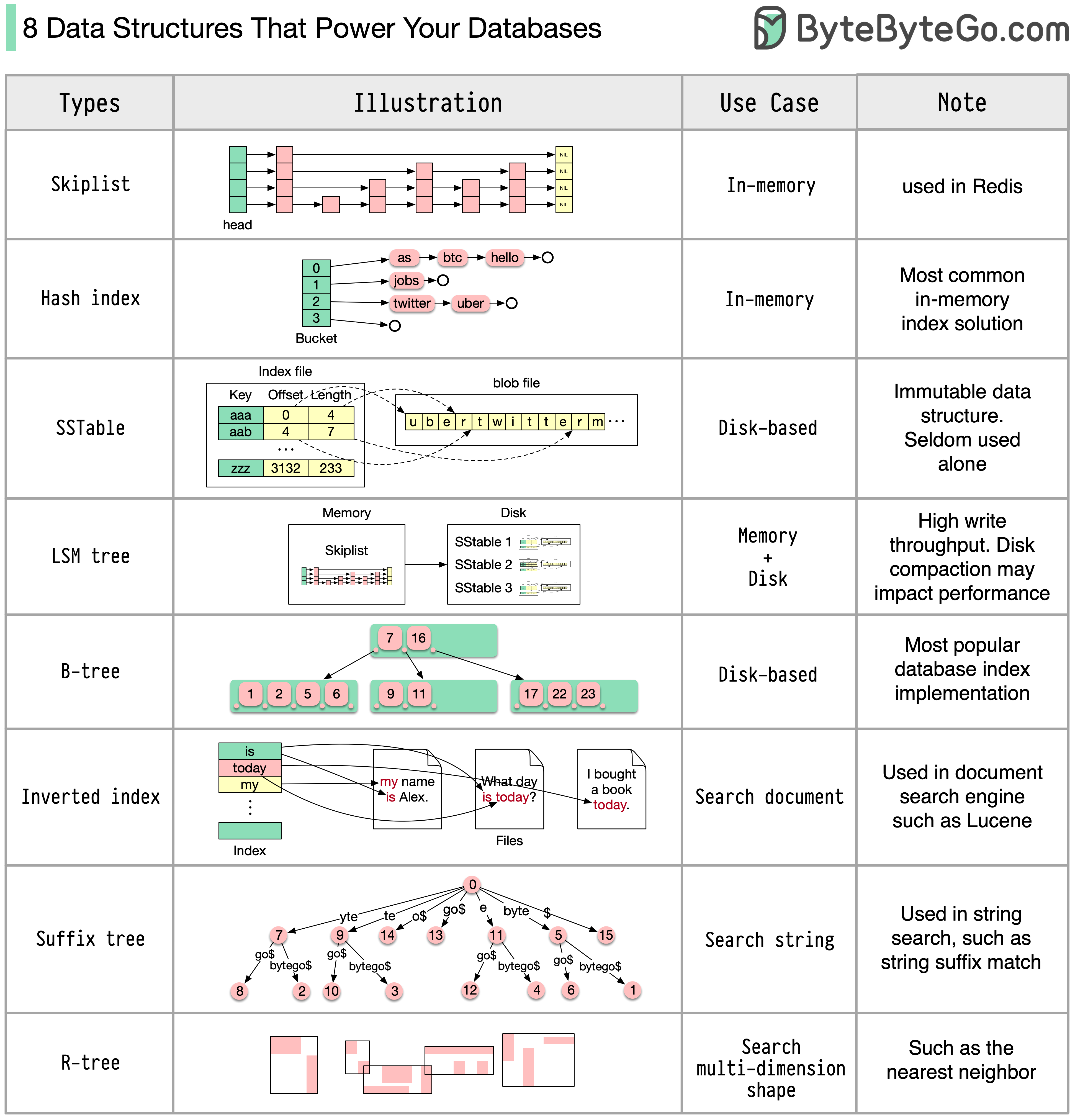
The answer will vary depending on your use case. Data can be indexed in memory or on disk. Similarly, data formats vary, such as numbers, strings, geographic coordinates, etc. The system might be write-heavy or read-heavy. All of these factors affect your choice of database index format.
The following are some of the most popular data structures used for indexing data:
- Skiplist: a common in-memory index type. Used in Redis
- Hash index: a very common implementation of the “Map” data structure (or “Collection”)
- SSTable: immutable on-disk “Map” implementation
- LSM tree: Skiplist + SSTable. High write throughput
- B-tree: disk-based solution. Consistent read/write performance
- Inverted index: used for document indexing. Used in Lucene
- Suffix tree: for string pattern search
- R-tree: multi-dimension search, such as finding the nearest neighbor
This is not an exhaustive list of all database index types.
8 Data Structures which Power Databases

- Skiplist: a common in-memory index type. Used in Redis
- Hash index: a very common implementation of the “Map” data structure (or “Collection”)
- SSTable: immutable on-disk “Map” implementation
- LSM tree: Skiplist + SSTable. High write throughput
- B-tree: disk-based solution. Consistent read/write performance
- Inverted index: used for document indexing. Used in Lucene
- Suffix tree: for string pattern search
- R-tree: multi-dimension search, such as finding the nearest neighbour

