christova  

RoadMap

#java #roadmap #javadeveloper #javadeveloperroadmap

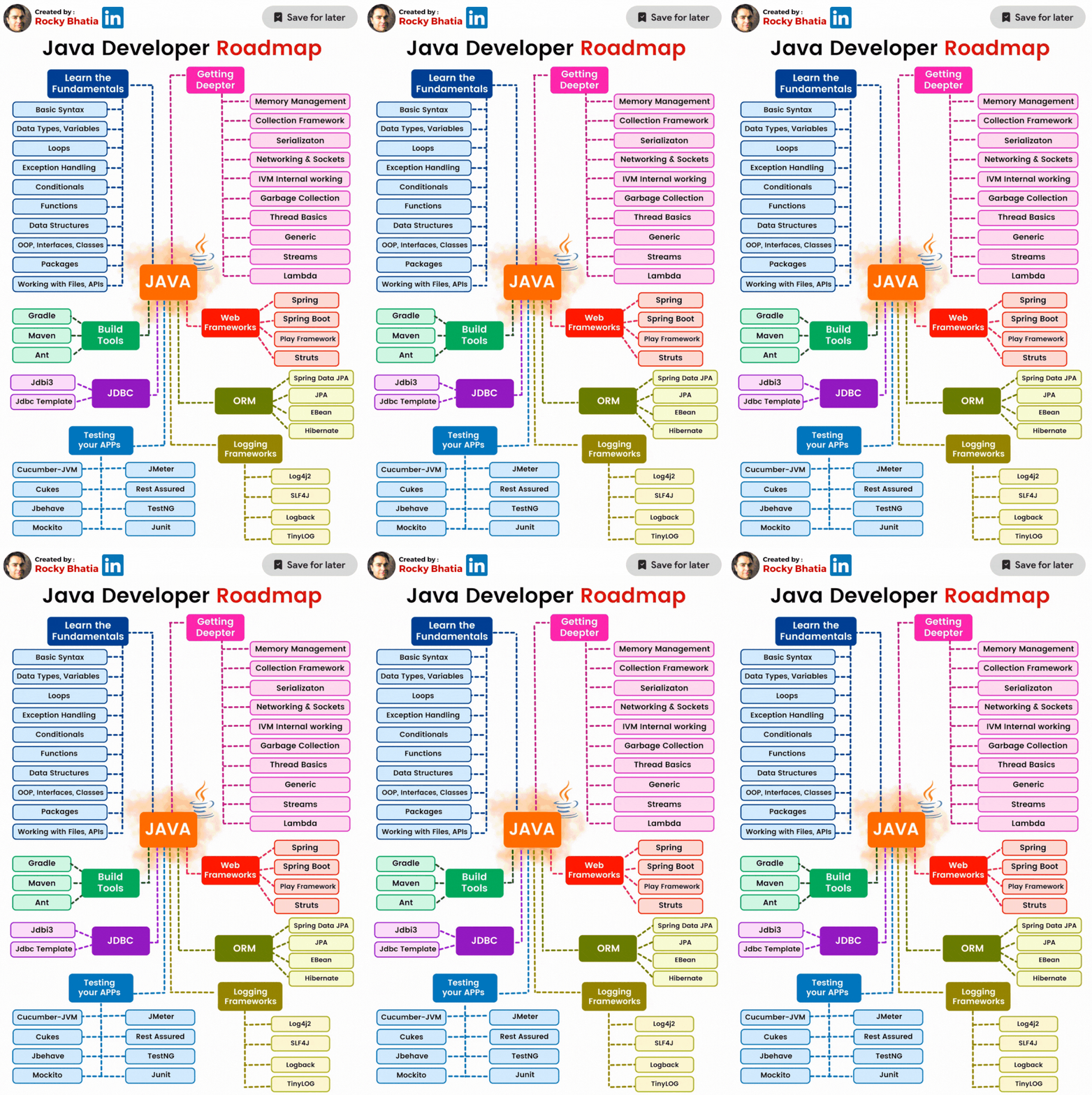
1. Learn the Fundamentals Core Java Concepts: Master the basics variables, data types, control structures, files, exception handling etc. ObjectOriented Programming (OOP): Understand key principles like encapsulation, inheritance, and polymorphism.

2. Getting Deeper Collections: Explore data structures like lists, sets, maps. Serialization: Understand how to convert Java objects into byte streams. Threading: Dive into concurrent programming for efficient multitasking. Streams and Lambdas: Leverage functional programming for cleaner code.

3. Build Tools Maven/Gradle: Learn popular build tools for project management and dependencies.

4. ORM Framework Hibernate or JPA: Dive into ObjectRelational Mapping for database interactions.

5. JDBC (Java Database Connectivity) Database Interactions: Understand how Java applications interact with databases.

6. Testing Your Apps JUnit: Master the widelyused testing framework for unit tests. Mockito: Explore mocking frameworks for effective unit testing. JMeter: Learn performance testing to ensure your application scales.

7. Logging Framework SLF4J and Logback/Log4j: Implement robust logging for debugging and monitoring.

8. Web Frameworks: Explore popular web frameworks such as Spring, Spring Boot, Play, and Struts for building robust and scalable web applications.
1. Collaboration Tools

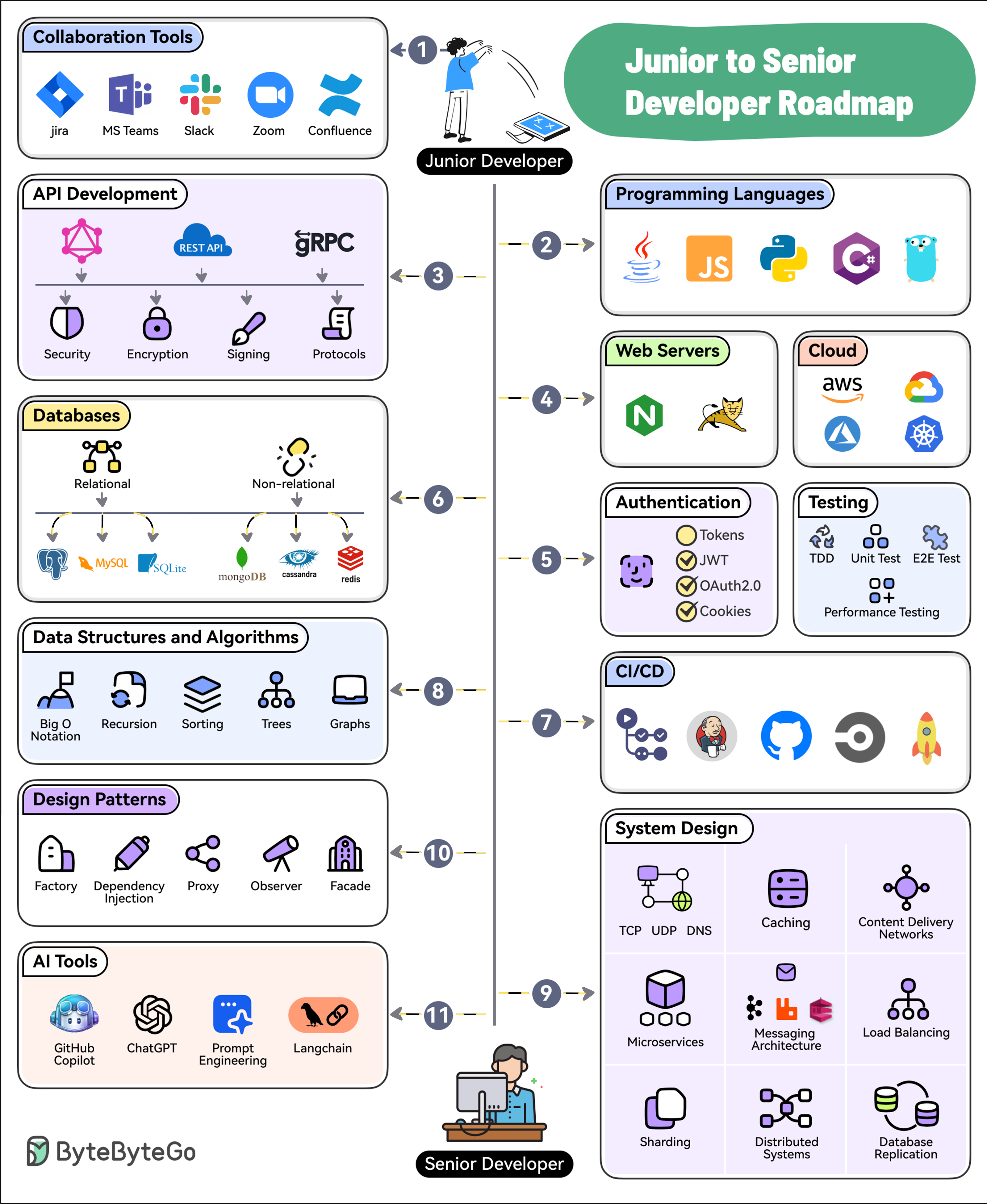
Software development is a social activity. Learn to use collaboration tools like Jira, Confluence, Slack, MS Teams, Zoom, etc.

2. Programming Languages

Pick and master one or two programming languages. Choose from options like Java, Python, JavaScript, C#, Go, etc.

3. API Development

Learn the ins and outs of API Development approaches such as REST, GraphQL, and gRPC.

4. Web Servers and Hosting

Know about web servers as well as cloud platforms like AWS, Azure, GCP, and Kubernetes

5. Authentication and Testing

Learn how to secure your applications with authentication techniques such as JWTs, OAuth2, etc. Also, master testing techniques like TDD, E2E Testing, and Performance Testing

6. Databases

Learn to work with relational (Postgres, MySQL, and SQLite) and non-relational databases (MongoDB, Cassandra, and Redis).

7. CI/CD

Pick tools like GitHub Actions, Jenkins, or CircleCI to learn about continuous integration and continuous delivery.

8. Data Structures and Algorithms

Master the basics of DSA with topics like Big O Notation, Sorting, Trees, and Graphs.

9. System Design

Learn System Design concepts such as Networking, Caching, CDNs, Microservices, Messaging, Load Balancing, Replication, Distributed Systems, etc.

10. Design patterns

Master the application of design patterns such as dependency injection, factory, proxy, observers, and facade.

11. AI Tools

To future-proof your career, learn to leverage AI tools like GitHub Copilot, ChatGPT, Langchain, and Prompt Engineering.

#Roadmap #Junior #Senior