concurrency
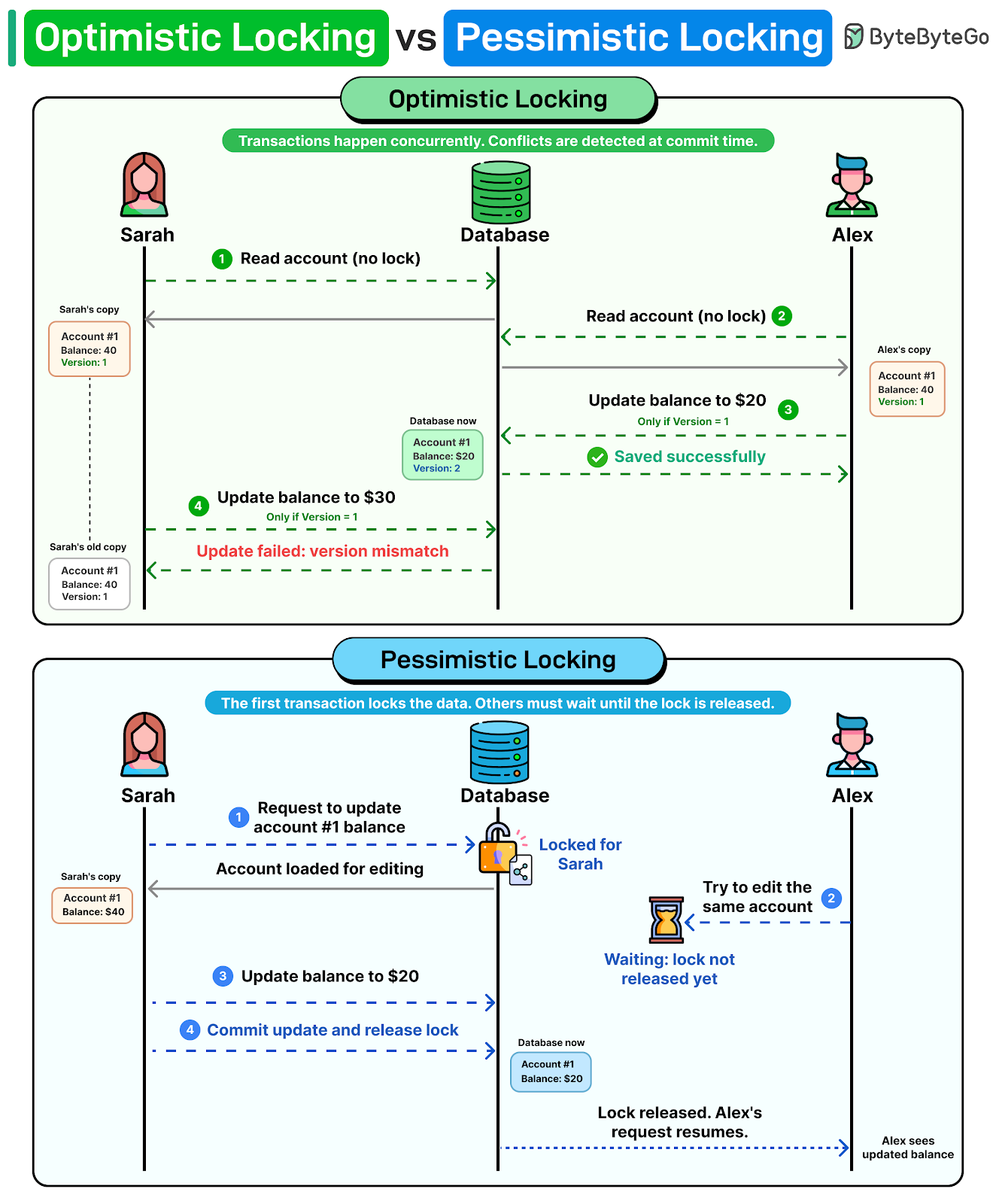

Concurrency Concepts
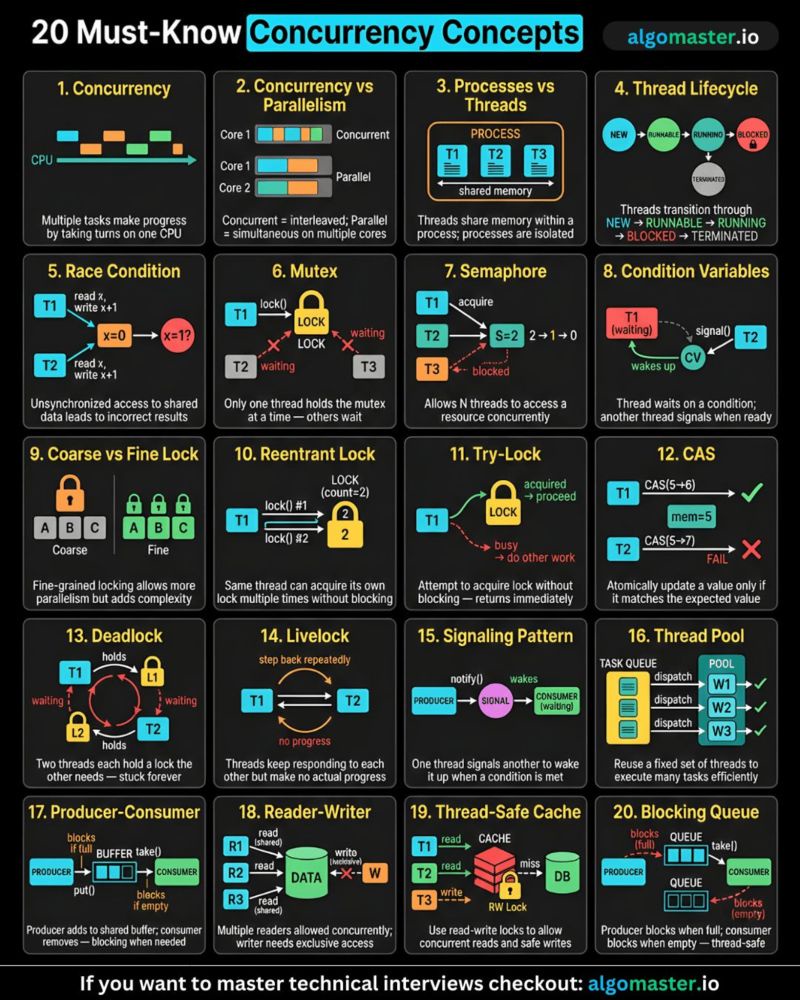
🧠 Why this matters more than you think Concurrency is not just theory. 👉 It shows up in: ⚡ Backend systems ⚡ Distributed systems ⚡ Real-world bugs (race conditions, deadlocks) ⚡ Performance optimization
And in interviews, it’s often the difference between “good” and “hire” 🔑 The 4 layers you should understand (instead of memorizing 20 items) ⚙️ Foundations 👉 Concurrency vs Parallelism 👉 Processes vs Threads 👉 Thread Lifecycle
If you don’t get this, everything else feels random. ⚠️ Problems (where most bugs live) 👉 Race Conditions 👉 Deadlocks 👉 Livelocks These are interview gold. Explain them well → instant signal of experience.
🔒 Control mechanisms 👉 Mutex 👉 Semaphores 👉 Condition Variables 👉 CAS (Compare-And-Swap) This is how you fix the above problems.
🧩 Patterns (what real systems use) 👉 Producer-Consumer 👉 Thread Pool 👉 Reader-Writer 👉 Blocking Queue 👉 Thread-safe Cache This is where theory meets system design.
🎯 How to actually study this (practical path) Don’t just read definitions. 👉 Step 1: Understand the problem (e.g., race condition) 👉 Step 2: Learn the primitive (mutex, semaphore) 👉 Step 3: See it in a pattern (producer-consumer) That’s how it sticks.
🎥 Must read resources (shared by Aashish) If you want to master concurrency and multi-threading interviews, go through these:
Concurrency Overview: https://lnkd.in/gbXNtx8i Concurrency vs Parallelism: https://lnkd.in/ggm3zxKi Processes vs Threads: https://lnkd.in/gjD7BE9D Thread Lifecycle: https://lnkd.in/gnraugyb Race Conditions: https://lnkd.in/gJBaBWa5 Mutex: https://lnkd.in/gU-6SvJh Semaphores: https://lnkd.in/gpcMAvvC Condition Variables: https://lnkd.in/gzD3RdWy Coarse vs Fine Locking: https://lnkd.in/giHCvjbK Reentrant Locks: https://lnkd.in/gjjtEZrm Try-Lock: https://lnkd.in/gc9Frvik CAS: https://lnkd.in/gzzvSW_W Deadlock: https://lnkd.in/gKtDZ9gD Livelock: https://lnkd.in/g8UTb86c Signaling Pattern: https://lnkd.in/gg8RxZBf Thread Pool: https://lnkd.in/g52TJUT3 Producer-Consumer: https://lnkd.in/g9P_Rh-6 Reader-Writer: https://lnkd.in/geAvZkRy Thread-safe Cache: https://lnkd.in/gPW9JnkH Blocking Queue: https://lnkd.in/gtKrDJiE
📚 One book that will change your understanding 👉 “Java Concurrency in Practice” – Brian Goetz
Even if you don’t use Java, this book builds rock-solid fundamentals.
💡 Final takeaway You don’t need to memorize all 20. 👉 Understand the patterns 👉 Know when things break 👉 Know how to fix them That’s what interviews are really testing.
This is the kind of resource you revisit again and again.
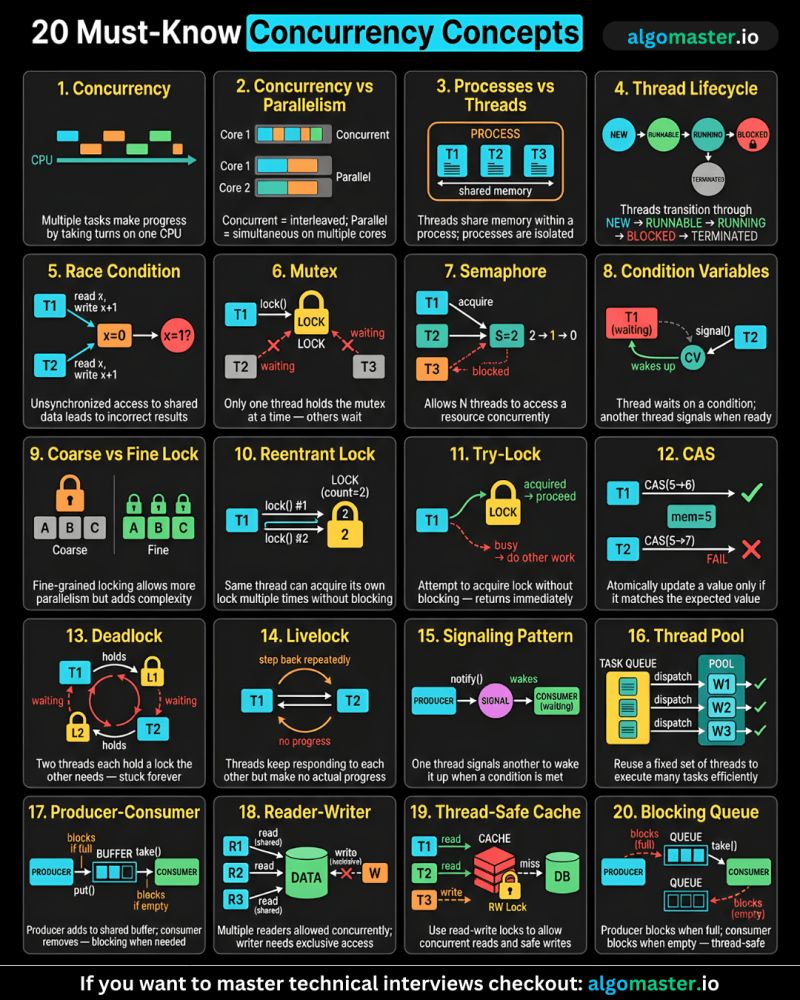
20 Must-Know Concurrency Concepts
#concurrency #threads #thread-safe #queue #locks
1. Concurrency Overview: https://lnkd.in/gbXNtx8i 2. Concurrency vs Parallelism: https://lnkd.in/ggm3zxKi 3. Processes vs Threads: https://lnkd.in/gjD7BE9D 4. Thread Lifecycle: https://lnkd.in/gnraugyb 5. Race Conditions: https://lnkd.in/gJBaBWa5 6. Mutex: https://lnkd.in/gU-6SvJh 7. Semaphores: https://lnkd.in/gpcMAvvC 8. Condition Variables: https://lnkd.in/gzD3RdWy 9. Coarse-grained vs Fine-grained Locking: https://lnkd.in/giHCvjbK 10. Reentrant Locks: https://lnkd.in/gjjtEZrm 11. Try-Lock: https://lnkd.in/gc9Frvik 12. Compare-and-Swap (CAS): https://lnkd.in/gzzvSW_W 13. Deadlock: https://lnkd.in/gKtDZ9gD 14. Livelock: https://lnkd.in/g8UTb86c 15. Signaling Pattern: https://lnkd.in/gg8RxZBf 16. Thread Pool Pattern: https://lnkd.in/g52TJUT3 17. Producer-Consumer Pattern: https://lnkd.in/g9P_Rh-6 18. Reader-Writer Pattern: https://lnkd.in/geAvZkRy 19. Thread-Safe Cache: https://lnkd.in/gPW9JnkH 20. Thread-Safe Blocking Queue: https://lnkd.in/gtKrDJiE
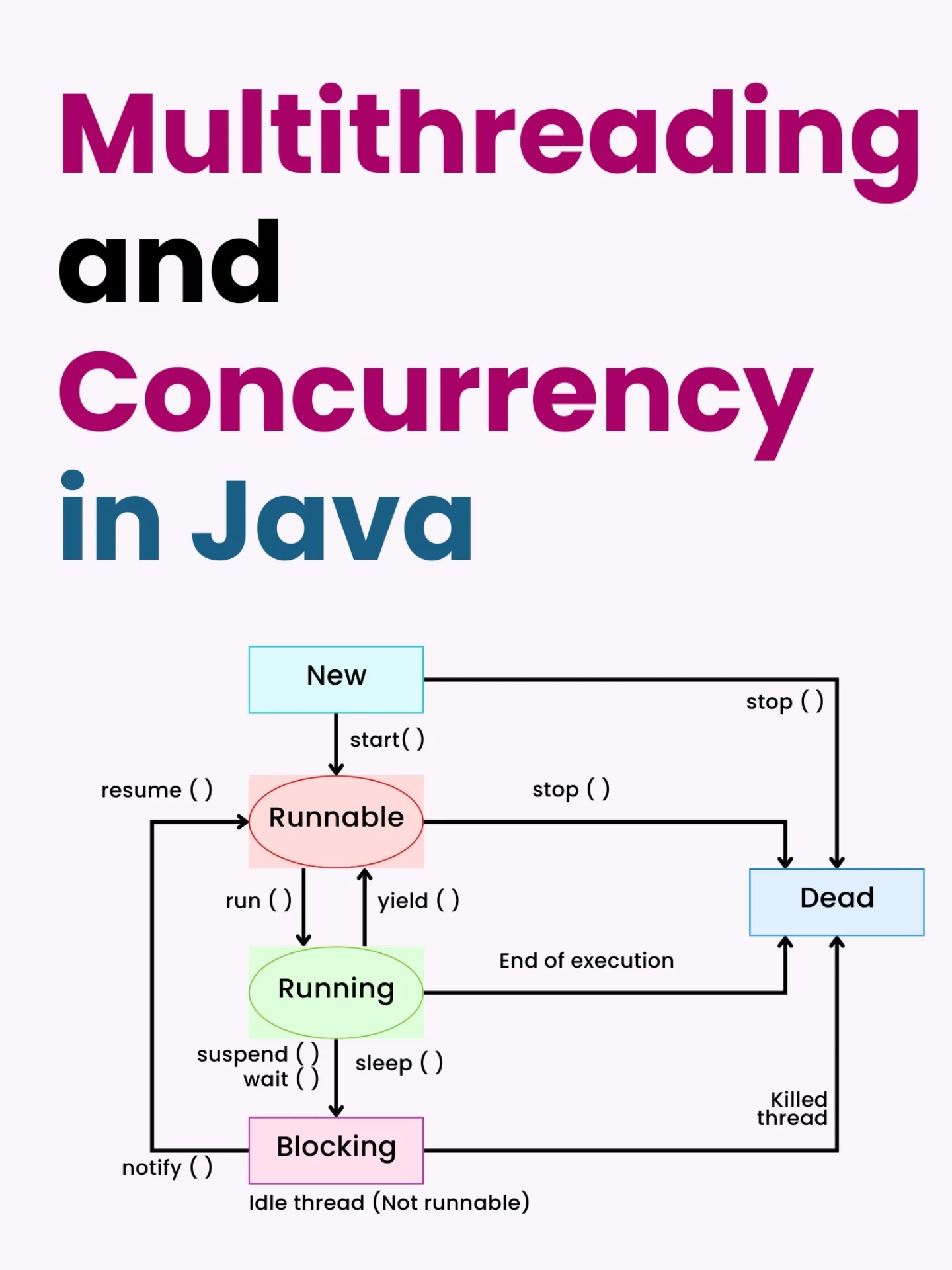
Multithreading and Concurrency in Java
Concurrency is NOT Parallelism
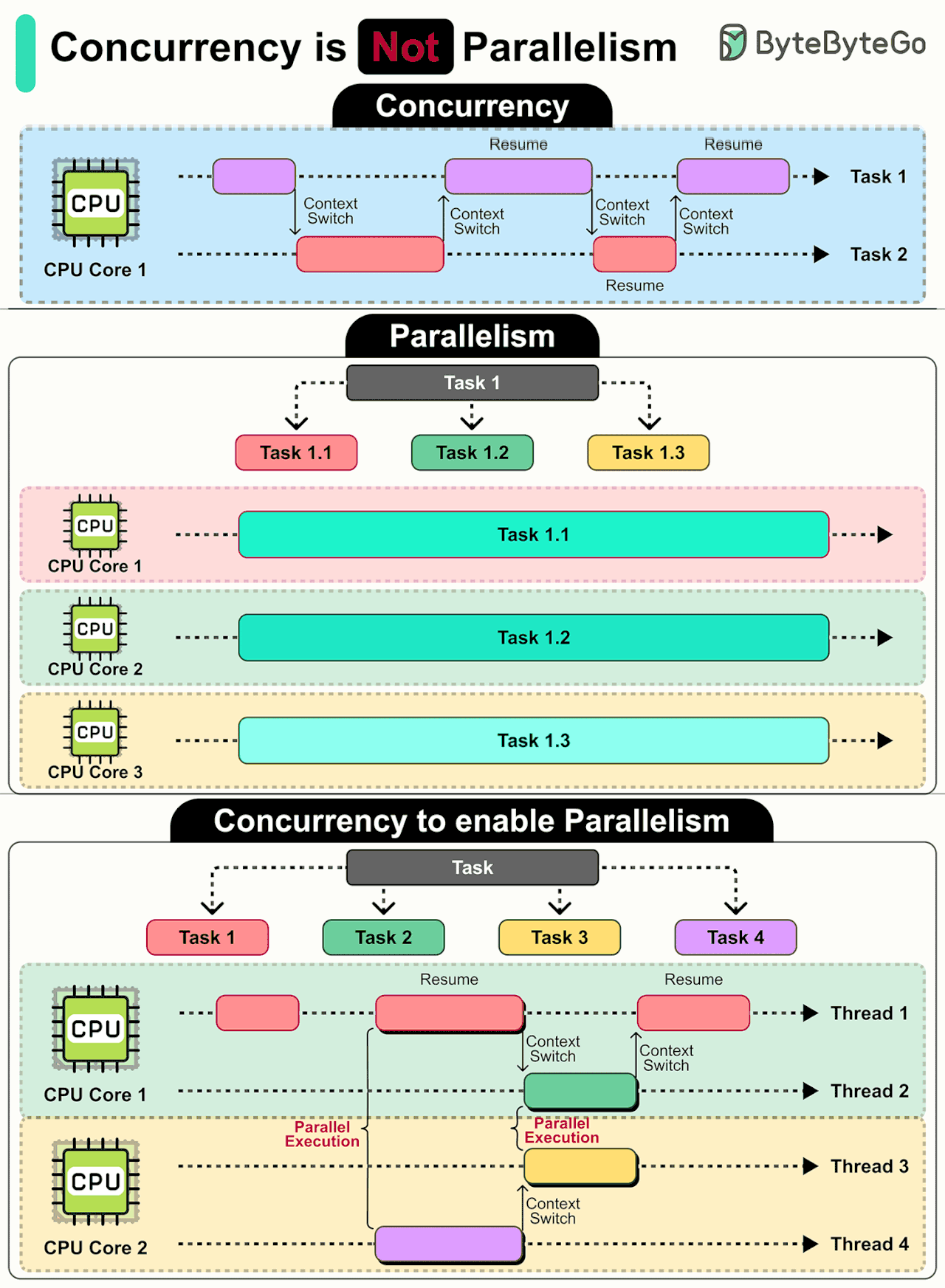
Concurrency vs Parallelism

Things Every Developer Should Know:
Concurrency is 𝐍𝐎𝐓 parallelism.
In system design, it is important to understand the difference between concurrency and parallelism.
As Rob Pyke(one of the creators of GoLang) stated:“ Concurrency is about 𝐝𝐞𝐚𝐥𝐢𝐧𝐠 𝐰𝐢𝐭𝐡 lots of things at once. Parallelism is about 𝐝𝐨𝐢𝐧𝐠 lots of things at once.” This distinction emphasizes that concurrency is more about the 𝐝𝐞𝐬𝐢𝐠𝐧 of a program, while parallelism is about the 𝐞𝐱𝐞𝐜𝐮𝐭𝐢𝐨𝐧.
Concurrency is about dealing with multiple things at once. It involves structuring a program to handle multiple tasks simultaneously, where the tasks can start, run, and complete in overlapping time periods, but not necessarily at the same instant.
Concurrency is about the composition of independently executing processes and describes a program's ability to manage multiple tasks by making progress on them without necessarily completing one before it starts another.
Parallelism, on the other hand, refers to the simultaneous execution of multiple computations. It is the technique of running two or more tasks or computations at the same time, utilizing multiple processors or cores within a computer to perform several operations concurrently. Parallelism requires hardware with multiple processing units, and its primary goal is to increase the throughput and computational speed of a system.
In practical terms, concurrency enables a program to remain responsive to input, perform background tasks, and handle multiple operations in a seemingly simultaneous manner, even on a single-core processor. It's particularly useful in I/O-bound and high-latency operations where programs need to wait for external events, such as file, network, or user interactions.
Parallelism, with its ability to perform multiple operations at the same time, is crucial in CPU-bound tasks where computational speed and throughput are the bottlenecks. Applications that require heavy mathematical computations, data analysis, image processing, and real-time processing can significantly benefit from parallel execution.