designprinciples
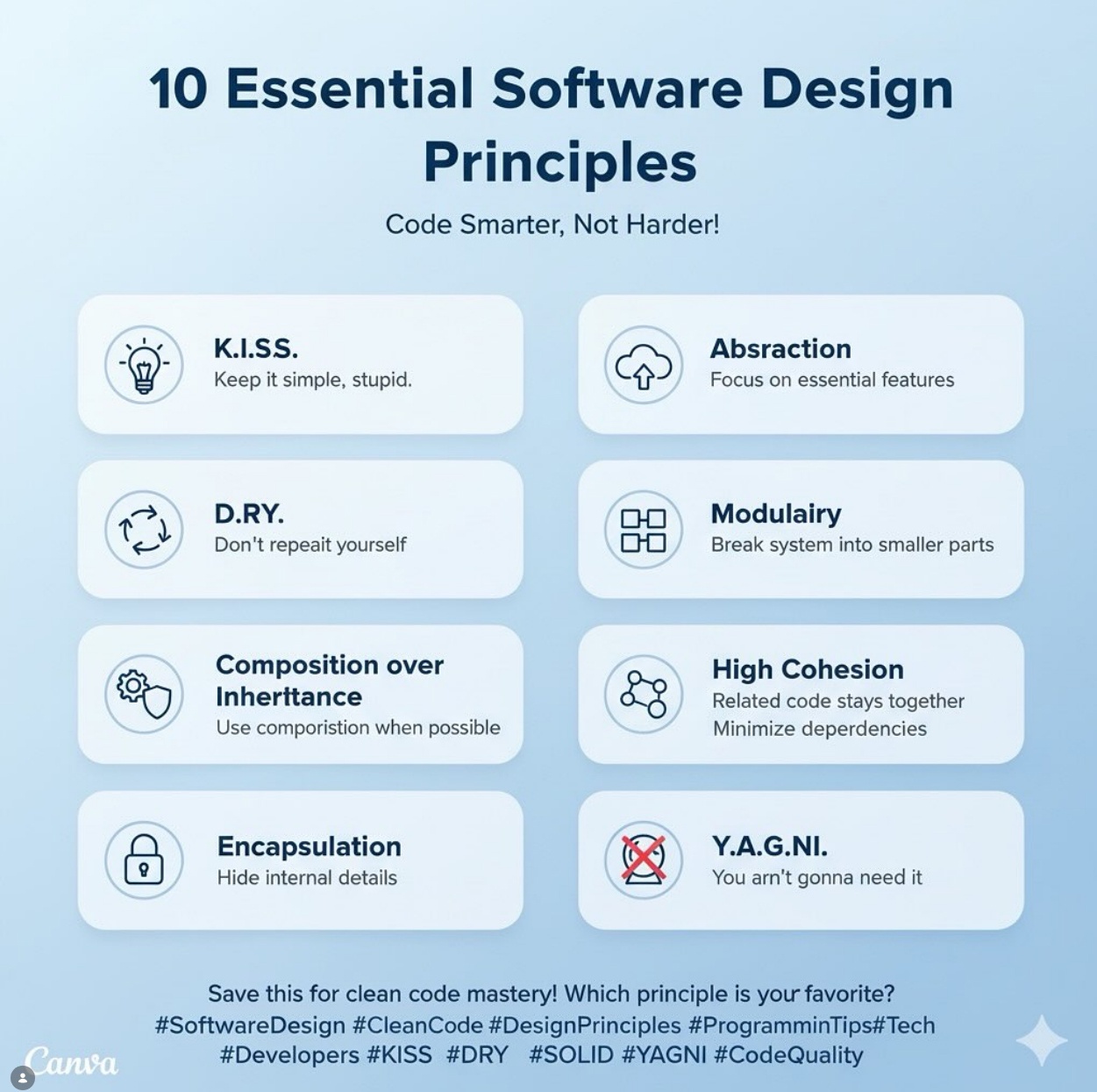
SOLID Principles
#solid #designprinciples #designpatterns #systemdesign
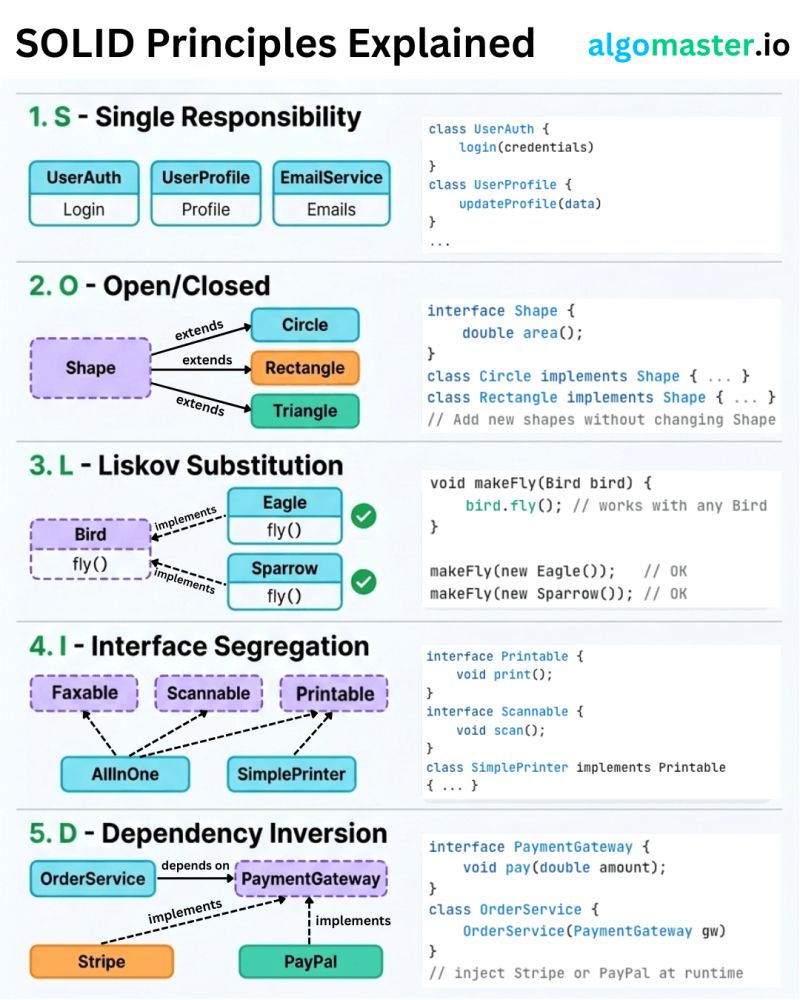
𝐒 – 𝐒𝐢𝐧𝐠𝐥𝐞 𝐑𝐞𝐬𝐩𝐨𝐧𝐬𝐢𝐛𝐢𝐥𝐢𝐭𝐲 𝐏𝐫𝐢𝐧𝐜𝐢𝐩𝐥𝐞 A class should have only one reason to change. - Example: Instead of one giant User class that handles authentication, profile updates, and sending emails, split it into UserAuth, UserProfile, and EmailService.
𝐎 – 𝐎𝐩𝐞𝐧/𝐂𝐥𝐨𝐬𝐞𝐝 𝐏𝐫𝐢𝐧𝐜𝐢𝐩𝐥𝐞 Classes should be open for extension but closed for modification. - Example: Define a Shape interface with an area() method. When you need a new shape, just add a Circle or Triangle class that implements it.
𝐋 – 𝐋𝐢𝐬𝐤𝐨𝐯 𝐒𝐮𝐛𝐬𝐭𝐢𝐭𝐮𝐭𝐢𝐨𝐧 𝐏𝐫𝐢𝐧𝐜𝐢𝐩𝐥𝐞 Subtypes must be substitutable for their base types without breaking behavior. - Example: If Bird has a fly() method, then Eagle and Sparrow should both work anywhere a Bird is expected.
𝐈 – 𝐈𝐧𝐭𝐞𝐫𝐟𝐚𝐜𝐞 𝐒𝐞𝐠𝐫𝐞𝐠𝐚𝐭𝐢𝐨𝐧 𝐏𝐫𝐢𝐧𝐜𝐢𝐩𝐥𝐞 Don't force classes to implement interfaces they don't use. - Example: Instead of one fat Machine interface with print(), scan(), and fax(), break it into Printable, Scannable, and Faxable. A SimplePrinter only implements Printable.
𝐃 – 𝐃𝐞𝐩𝐞𝐧𝐝𝐞𝐧𝐜𝐲 𝐈𝐧𝐯𝐞𝐫𝐬𝐢𝐨𝐧 𝐏𝐫𝐢𝐧𝐜𝐢𝐩𝐥𝐞 High-level modules should not depend on low-level modules. Both should depend on abstractions. - Example: Your OrderService should depend on a PaymentGateway interface, not directly on Stripe or PayPal.
The real power of SOLID is not in following each principle in isolation. It's in how they work together to make your code easier to change, test, and extend.
Container Design Principles
#container #containerisation #designprinciples
Containerization has revolutionized the way applications are developed, deployed, and managed. As organizations increasingly adopt container technologies like Docker and Kubernetes, adhering to fundamental design principles becomes crucial for ensuring efficiency, scalability, and maintainability.
In this article, we explore key container design principles that contribute to the success of containerized applications.
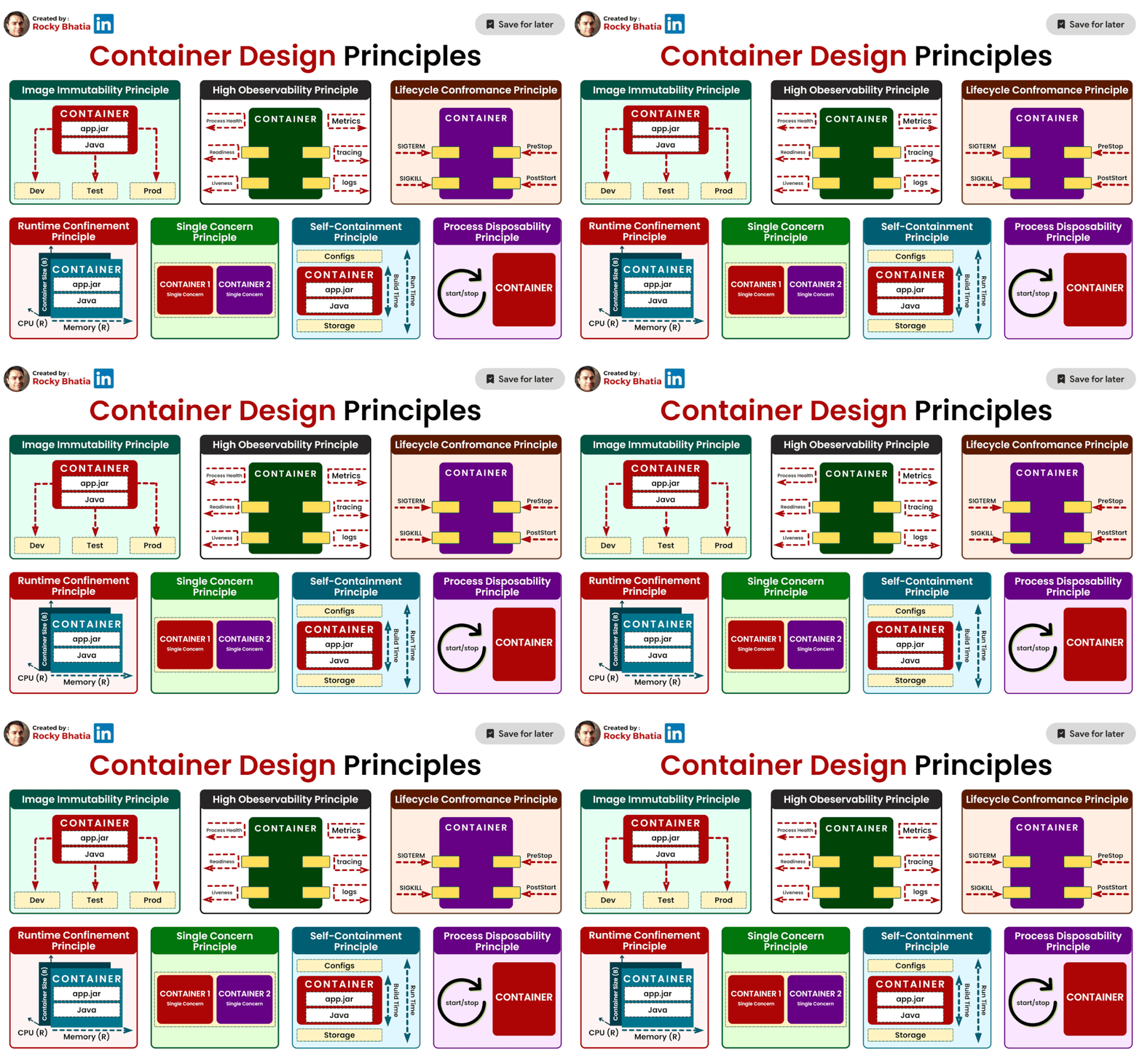
Image Immutability Principle: Container images play a pivotal role in the containerization process. The Image Immutability Principle emphasizes that once a container image is created, it remains unchanged throughout its lifecycle. Any updates or modifications result in the creation of a new image. This principle promotes consistency and reproducibility, ensuring that containers run reliably across various environments.
High Observability Principle: Observability is a critical aspect of containerized applications. The High Observability Principle advocates for comprehensive monitoring and logging mechanisms within containers. This includes tools and practices that provide insights into the container's performance, health, and interactions with other components. A well-observed containerized environment facilitates quick issue detection, troubleshooting, and optimization.
Lifecycle Conformance Principle: Managing the lifecycle of containers involves various stages, from creation and deployment to scaling and termination. The Lifecycle Conformance Principle encourages adhering to a standardized and consistent lifecycle. This ensures that containers are created, updated, and terminated in a predictable manner, simplifying the overall management and orchestration of containerized applications.
Runtime Confinement: Runtime confinement is about isolating containerized applications from their host environments and other containers. This principle ensures that the application runs consistently across diverse environments, preventing conflicts and interference with other services. Runtime confinement contributes to the security, stability, and portability of containerized applications.
Single Concern Principle: The Single Concern Principle advocates for designing containers with a singular focus or responsibility. Each container should perform a specific task or function, promoting modularity and simplicity. By adhering to this principle, containerized applications become more maintainable, scalable, and easier to comprehend, fostering a microservices-oriented architecture.
Self-Containment Principle: Containers should encapsulate all the dependencies and runtime requirements needed to execute an application. The Self-Containment Principle emphasizes that containers should be self-sufficient, eliminating external dependencies on the host system. This ensures consistency and portability, allowing containers to run seamlessly across different environments.
Process Disposability Principle: The Process Disposability Principle encourages treating containers as ephemeral entities. Containers should be designed to start quickly, handle their tasks efficiently, and terminate gracefully when their purpose is fulfilled. This principle aligns with the scalability and resilience aspects of containerized applications, enabling dynamic and efficient resource utilization.
Conclusion: Adhering to these container design principles is essential for building robust, scalable, and maintainable containerized applications. By embracing image immutability, high observability, lifecycle conformance, runtime confinement, single concern, self-containment, and process disposability, organizations can unlock the full potential of container technologies and streamline their development and deployment workflows.