Redis Use Cases
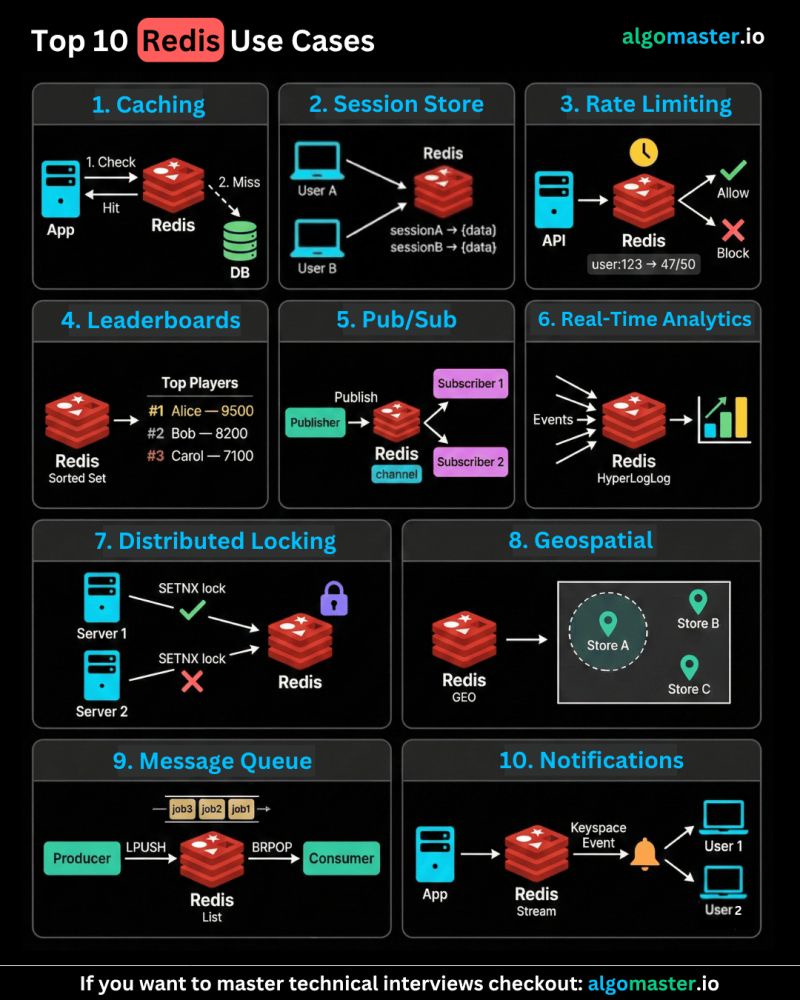
1. 𝐂𝐚𝐜𝐡𝐢𝐧𝐠 The most common use case. Your app checks Redis before hitting the database. If the key exists, return it instantly. If not, query the DB, store the result in Redis, and serve it.
2. 𝐒𝐞𝐬𝐬𝐢𝐨𝐧 𝐒𝐭𝐨𝐫𝐞 When a user logs in, store their session data (user ID, roles, preferences) in Redis. Every subsequent request just looks up the session key.
3. 𝐑𝐚𝐭𝐞 𝐋𝐢𝐦𝐢𝐭𝐢𝐧𝐠 Redis makes rate limiting trivial. Use INCR to increment a request counter and EXPIRE to reset it after a fixed window. If the count exceeds the limit, throttle or block the request.
4. 𝐋𝐞𝐚𝐝𝐞𝐫𝐛𝐨𝐚𝐫𝐝𝐬 Redis Sorted Sets keep users ranked by score in real time. You can update scores, fetch the top N users, and find a user’s rank efficiently in O(log N) operations.
5. 𝐏𝐮𝐛/𝐒𝐮𝐛 𝐌𝐞𝐬𝐬𝐚𝐠𝐢𝐧𝐠 Publishers send messages to a channel, and subscribers receive them instantly. Great for chat, live notifications, and dashboards. Trade-off: messages are fire-and-forget.
6. 𝐑𝐞𝐚𝐥-𝐓𝐢𝐦𝐞 𝐀𝐧𝐚𝐥𝐲𝐭𝐢𝐜𝐬 Use counters and HyperLogLog to track clicks, views, searches, unique visitors, and active users with very low memory usage.
7. 𝐃𝐢𝐬𝐭𝐫𝐢𝐛𝐮𝐭𝐞𝐝 𝐋𝐨𝐜𝐤𝐢𝐧𝐠 Redis SETNX (SET if Not eXists) lets you acquire a lock atomically. Set it with a TTL so locks auto-release if a process crashes. For stronger guarantees, use the Redlock algorithm.
8. 𝐆𝐞𝐨𝐬𝐩𝐚𝐭𝐢𝐚𝐥 𝐐𝐮𝐞𝐫𝐢𝐞𝐬 Redis GEO commands let you store coordinates and query nearby locations, such as restaurants within 5 km or drivers near a user. It uses sorted sets with geohash encoding under the hood.
9. 𝐌𝐞𝐬𝐬𝐚𝐠𝐞 𝐐𝐮𝐞𝐮𝐞 Redis Lists with LPUSH and BRPOP can act as a lightweight queue for simple background jobs. For more advanced use cases, Redis Streams are a better fit.
10. 𝐑𝐞𝐚𝐥-𝐓𝐢𝐦𝐞 𝐍𝐨𝐭𝐢𝐟𝐢𝐜𝐚𝐭𝐢𝐨𝐧𝐬 Redis Streams provide an append-only log with consumer groups. Keyspace Notifications let you subscribe to changes on specific keys. Useful for notifications, activity feeds, background processing, and real-time pipelines.